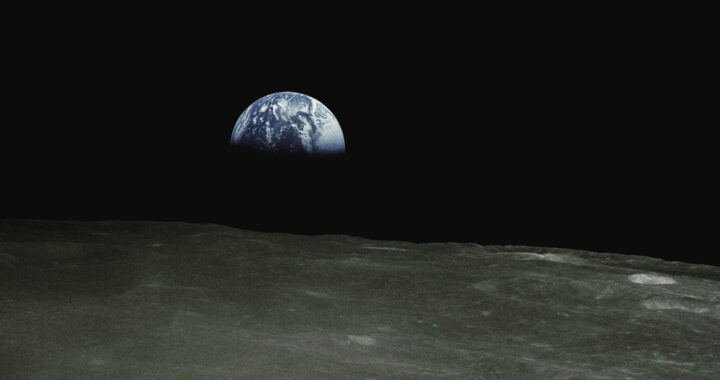
For years, scientists have identified terrestrial signatures in lunar soil samples brought back by the Apollo missions. These include isotopes of oxygen, nitrogen, and noble gases. Hence, following these findings, others have assumed that they were blown to the Moon during a brief period when Earth had no magnetic field. However, for a team of researchers led by astronomy professor and computational scientist Jonathan Carroll-Nellenback, these traces of materials from Earth are leaking to the moon despite the presence of the magnetosphere.
Earth is Leaking: The Magnetosphere Serves as an Invisible Bridge that Leaks Atmospheric Materials to the Moon
Simulations by a team of researchers revealed that the Earth is indirectly terraforming the surface of the Moon by leaking some traces of its terrestrial materials. Ions that escaped the atmosphere of the Earth are guided to the Moon via the elongated side of the magnetosphere.
Overview
The researchers hypothesized that the magnetosphere, the comet-shaped bubble that protects the planet from solar wind or harmful charged particles from the Sun and cosmic rays, is not a sealed container. They specifically believed that it leaked ions from the atmosphere of the Earth into space. These ions are then transported to the Moon.
Advanced three-dimensional magnetohydrodynamic simulations were performed to test the above hypothesis. These involved treating the plasma and gas coming off of Earth as a fluid that conducts electricity. The goal of the simulations was to see if ions could actually travel from Earth to the Moon without being blocked by the magnetic field.
The strength of the solar wind and the orientation of the magnetic tilt of the Earth were changed to determine how different conditions affect the hypothesized leak. The 28-day orbit of the Moon was also mapped out to look at the magnetotail window and further calculate its phase angle or its specific position relative to the Earth and Sun.
Findings
Findings from the simulations revealed that for about 5 days every month, the Moon passes through the magnetotail, a long tail of the magnetic field of the Earth stretched by solar wind. During this window, the Moon acts like a sponge, soaking up oxygen, nitrogen, and hydrogen ions that have escaped from the upper atmosphere of the Earth.
The simulations may also explain the presence of water on the Moon. Take note that the lunar soil is already rich in oxygen locked inside silica and iron oxides. However, when the high-energy hydrogen ions from Earth strike the lunar surface, a process called chemical reduction occurs. This frees the locked oxygen to bond with hydrogen ions.
Essentially, as the solar wind blows past Earth, it stretches the magnetic field into a tail-like shape called the magnetotail. Once a month, as the Moon orbits Earth, it passes through this magnetotail for about five days, where it is then bombarded by a stream of terrestrial ions traveling down the magnetotail. These ions are implanted into the lunar soil.
Implications
Many scientists believed that the Moon was mostly influenced by the Sun. The team of researchers led by J. Carroll-Nellenback suggests otherwise. Their findings showed that the Earth is actually indirectly terraforming the Moon as traces of its terrestrial materials escape its atmosphere and are guided on the lunar surface by the magnetosphere.
In addition, because the Moon does not have plate tectonics to reshape and recycle the lunar surface like Earth does, the terrestrial ions or particles trapped in its lunar soil from billions of years ago are still there. This makes the Moon a chemical recorder or a figurative time capsule that contains a detailed record of the ancient atmosphere of Earth.
Examining lunar samples can help reconstruct what the atmosphere of the Earth was like billions of years ago. Specifically, by looking at different layers of lunar soil, scientists can grasp what the air on Earth was like 2 to 3 billion years ago. This could help in understanding further the Great Oxidation Event and the evolution of early life.
FURTHER READING AND REFERENCE
- Paramanick, S., Blackman, E. G., Tarduno, J. A., and Carroll-Nellenback, J. 2025). “Terrestrial Atmospheric Ion Implantation Occurred in the Nearside Lunar Regolith During the History of Earth’s Dynamo.” Communications Earth & Environment. 6(1). DOI: 1038/s43247-025-02960-4