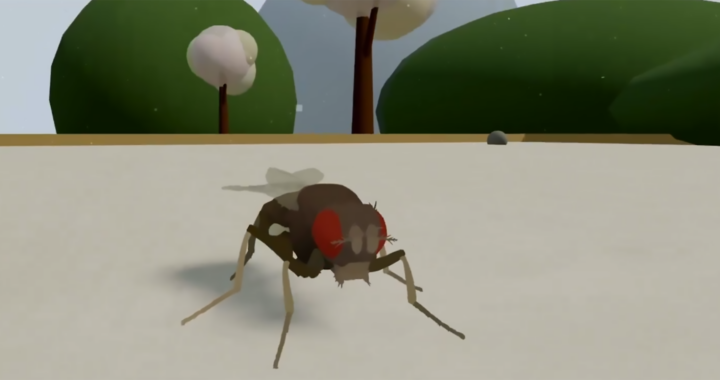
Scientists at Eon Systems, a neurotechnology company based in San Francisco and focused on whole-brain emulation, successfully copied the biological brain of a fruit fly, or Drosophila melanogaster, and simulated it in a computer to control a virtual fruit fly.
A Digital Fruit Fly Takes Flight: Scientists at a Neurotech Company Demonstrated the First Whole-Brain Emulation and Simulation in Action By Recreating a Fruit Fly Brain in a Computer
Scientists transformed the neuronal wiring map of a fruit fly brain into a functioning computational model. Sensory inputs from the environment feed into the neural network, while outputs from motor neurons generate movement, creating a continuous feedback loop between perception, neural computation, and action.
Emulating and Simulating the Biological Brain of a Fruit Fly
The fruit fly brain has between 130000 and 140000 neurons. These neurons form about 50 million synaptic connections. Scientists have created a connectome, or a complete wiring map, of this brain. Note that a connectome is essentially a full map showing which neuron connects to which, how many connections exist, and how signals might travel through the neural network.
Note that the undertaking was based on a huge international initiative called FlyWire. A report by researchers Sven Dorkenwald et al., published in Nature in October 2024, presented the complete wiring diagram of an adult fruit fly to offer insights into how its hundreds of thousands of neurons and millions of synapses control not only movement but also behavior.
The FlyWire initiative is fundamentally a collaboration between human researchers and relevant artificial intelligence systems for reconstructing the full brain connectome of the fruit fly. Hundreds of scientists worked to image a complete adult fruit fly brain using electron microscopy. These images are then aligned and segmented using automated image analysis.
Nevertheless, using the wiring diagram from FlyWire, Eon Systems scientists simulated the neural activity on a computer to connect it to the virtual body of a simulated fruit fly. The results showed that the simulated neural network produced behaviors similar to those of real fruit flies when stimulated. This has implications for brain emulation research and artificial intelligence.
Overview of the Emulation and Simulation Approach
• Scientists Used the Neural Map of a Fruit Fly Brain and Recreated that Mapped Brain Inside a Computer
They created a complete neuronal wiring diagram showing how about 140000 neurons connect to each other. Each neuron, connection, and synapse is simulated so electrical signals can travel through the network like in a real brain.
• The Simulated Brain is Then Connected to a Virtual Body or a Digitized Fruit Fly in a Virtual Environment
The simulated brain of the fruit fly receives various sensory inputs, like vision or touch, from a digital environment to observe its behaviors and demonstrate how real behaviors can be simulated using an actual brain emulation.
• Signals are Processed by the Simulated Brain while the Virtual Body Moves and Sends New Sensory Signals Back
Neurons activate and send signals through the network according to the real wiring. These signals move the legs, wings, or mouthparts of the virtual fly. Movement changes what the virtual fly senses. This creates a closed and continuous loop.
Implications for Brain Emulation and Artificial Intelligence
American research scientist and entrepreneur Alexander D. Wissner-Gross, who has a financial interest in Eon Systems, explained in an article published on X that the aforementioned approach is not the usual route used in AI. Most AI behaviors are based on an artificial neural network and are trained using reinforcement learning or through a trial-and-error approach.
Furthermore, in the field of brain simulation, there are two older approaches. The first one involves simulating a brain but without a body. The second approach centers on creating and animating a virtual or digital body and controlling it with AI training. Eon Systems showed that brain emulation can be done by combining a biological neural network and body simulation.
It is important to underscore the fact that the brain emulation is based on an actual biological brain wiring. Thus, instead of using artificial neural networks and reinforcement training, the resulting system uses real neural connections, simulates neural signals traveling through them, outputs motor commands, and moves a simulated body in a virtual environment.
Earlier versions of the system predicted behaviors such as feeding responses, sensory reactions, and grooming movements. The same neural cascades occurred in the simulation. The newer system specifically demonstrated a closed sensorimotor loop in which the simulated organism can sense, think, act, and react in a continuous cycle within the virtual environment.
FURTHER READINGS AND REFERENCES
- Dorkenwald, S., Matsliah, A., Sterling, A. R., Schlegel, P., Yu, S., McKellar, C. E., Lin, A., Costa, M., Eichler, K., Yin, Y., Silversmith, W., Schneider-Mizell, C., Jordan, C. S., Brittain, D., Halageri, A., Kuehner, K., Ogedengbe, O., Morey, R., Gager, J., … Zandawala, M. 2024. “Neuronal Wiring Diagram of An Adult Brain.” Nature. 634(8032): 124-138. DOI: 1038/s41586-024-07558-y
- Eon Systems. n.d. Eon. Eon Systems. Available online
- n.d. “About FlyWire.” FlyWire. Available online
- Wissner-Gross, A. D. 7 March 2026. “The First Multi-Behavior Brain Upload.” X. Available online