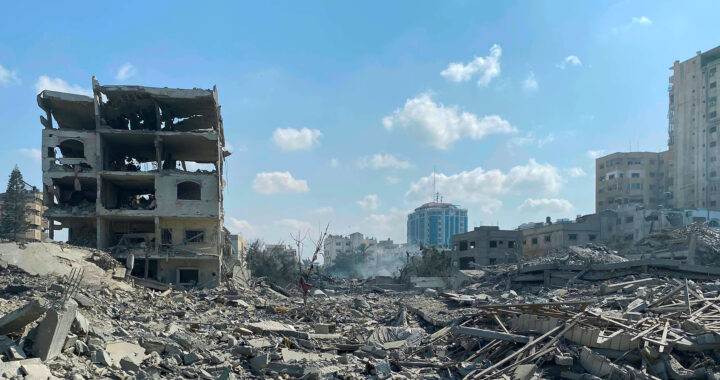
Official data on deaths are often distorted, incomplete, or inconsistent in conflict zones. This comes from under-reporting, missing demographic details, and breakdowns in record-keeping. Gaza has demonstrated these problems. Researchers at the Max Planck Institute for Demographic Research and the Centre for Demographic Studies intended to solve this issue.
Reconstructing Reality Using Pseudo-Bayesian: How Scientists Calculated the Death Toll in Gaza Under Data Uncertainty
Scientists developed a novel statistical model to expose how disrupted reporting systems mask the true human cost of war. Their analysis shows staggering death totals, demographic patterns resembling mass atrocities, and life expectancy collapsing by more than 40 percent.
Key Issues with Casualty Reporting in Gaza
Capturing official and reliable data on deaths in conflict zones is critically important for a variety of ethical, legal, and humanitarian reasons. These include use for investigating potential violations of International Humanitarian Law and International Human Rights. Casualty data are also crucial for assessing vulnerable groups, intervention points, and indirect effects.
Moreover, in a polarized environment, official and methodologically rigorous data helps counter false information spread through propaganda. Capturing the human cost of a conflict as accurately as possible is also important in communicating the gravity of the situation to the international community to pressure governments and other non-state actors to act.
The conflict in Gaza often faces immense challenges in data collection. These include impairment of relevant infrastructures and institutions like hospitals and media organizations, secure access to ground realities in hard-hit areas, mass displacement and the scattering of records, and political sensitivity of data reporting and disputes over the validity of official numbers.
A team of researchers led by Diego Alburez-Gutierrez used a pseudo-Bayesian statistical model to account for uncertainty in death toll and age‑sex distribution. The model is called pseudo-Bayesian because it is based on the core principles of Bayesian reasoning but does not completely adhere to the strict mathematical requirements of a formal Bayesian framework.
Findings from the Pseudo-Bayesian Model
Note that the researchers first gathered every available source of data and assumed that the datasets were imperfect. They used the pseudo-Bayesian model to examine thousands of possibilities and calculate the most likely range. The model essentially embraced uncertainty instead of ignoring it. This enabled better estimates and a war versus non-war comparison.
A set of findings quantified the human cost of the Gaza conflict despite severe data limitations. By modeling uncertainty, reconstructing missing demographic information, and comparing outcomes with a no-war scenario, the researchers revealed patterns of mortality and demographic loss that would otherwise remain obscured. Below are more specific details:
• Estimated Violent Deaths in Gaza
The model showed about 78,318 violent deaths from October 2023 to December 2024, with a credible range of 70,614 to 87,504. These likely understate the full toll. Continued conflict suggests that overall mortality has surpassed 100,000 by late 2025.
• Drastic Collapse in Life Expectancy
Life expectancy at birth fell by more than 40 percent in 2023-2024 compared with a no-war scenario. The analysis shows losses exceeding 34 years in each year. This is one of the most abrupt demographic declines documented in a modern conflict.
• Genocide-Pattern Mortality Distribution
The age and sex distribution of deaths resembles patterns observed in UN datasets on mass atrocities. This indicates uneven deaths among children, women, and non-combatant age groups. The study does not provide any legal classification or allegation.
• Severe Under-Reporting and Missing Data
The conflict produced unreliable casualty reporting with gaps in demographic data. The study concludes that official figures likely underestimate the true toll and that raw reports cannot fully capture the scale of deaths under the conditions of war.
Significance for Conflict Mortality Research
It is worth underscoring the fact that estimates included only direct violent fatalities. Deaths from lack of adequate medical care, disease, malnutrition, dehydration, or infrastructure collapse remain uncounted. This further suggests that the numbers produced by the researchers still represent a conservative estimate, and the true human cost is significantly higher.
Nevertheless, despite the aforesaid caveat, the pseudo-Bayesian model demonstrates how to derive credible demographic metrics even when direct measurements are unreliable or nonexistent. Its treatment of uncertainty, use of multiple sources, and reconstruction of missing details offer a replicable approach for other conflict zones with fragmented data.
The magnitude of mortality and loss of life expectancy in Gaza due to the Israel-Hamas War signals a deep demographic shock that will reshape the age structure and the entire population in the region for decades to come. Losses of children and young adults, along with disruptions in fertility and survival, indicate a prolonged direction of population recovery.
FURTHER READING AND REFERENCE
- Gómez-Ugarte, A. C., Chen, I., Acosta, E., Basellini, U., and Alburez-Gutierrez, D. 2025. “Accounting for Uncertainty in Conflict Mortality Estimation: An Application to the Gaza War in 2023-2024.” Population Health Metrics. 23(1). DOI: 10.1186/s12963-025-00422-9