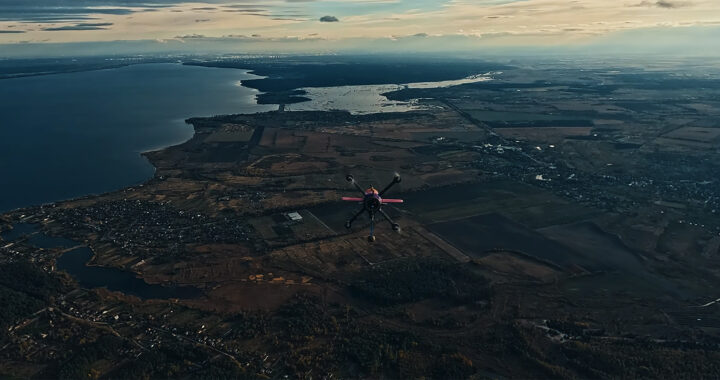
Ukraine, during the initial years of the Russia-Ukraine War, was forced to use multi-million dollar interceptor missiles from Western countries to defend itself against Iranian-made Shahed and other drones from Russia. However, as it learns through the war, it has developed and deployed cost-effective defense tactics and drone technologies against modern drone assaults.
Ukrainian Defensive Strategy Against Drones From Russia: Evening Out Air Defense Economics Via Relatively Low-Cost Interceptor Drones
The government of Ukraine has turned aerial defense into an economic strategy as much as a military one. Specifically, instead of firing expensive surface-to-air missiles worth hundreds to millions of thousands of dollars, defenders increasingly deploy inexpensive interceptor drones costing only thousands.
Defense Against Shahed Drone
A Patriot interceptor costs about 3 million U.S. dollars. Each NASAMS round costs about 1 million U.S. dollars. A Shahed drone costs Russia only about 35000 U.S. dollars. This imbalance in air defense economics has also been seen in the 2026 war with Iran, in which U.S. allies in the Middle East use expensive interceptors to defend against Iranian drones.
Nevertheless, as it becomes more experienced in its ongoing defense against Russian aggression, the government of Ukraine has turned its attention to interceptor drones. For example, in 2025, it produced about 100000 interceptor drones to ramp up both its stockpile and defense against drone assaults. This is an eightfold increase over previous periods.
The interceptor drones of Ukraine were credited with over 70 percent of Shahed drone shootings over Kyiv in February 2026 alone. The country is also establishing a designated drone line. This is a 15-kilometer stretch of a kill zone across the front lines designed to catch threats from the air before they reach civilian infrastructure and population centers.
Another integral part of the strategy of Ukraine against drones is drone warfare gamification. This involves using a video-game-style points system that encourages and incentivizes not only drone operators and volunteers but also rallies drone manufacturers and other innovators to improve and expand further the drone warfare and drone defense strategy of Ukraine.
Types of Interceptor Drones
Ukraine has developed and deployed different classes of interceptor drones to counter or defend against loitering munitions, reconnaissance drones, and Shahed-type attack drones. Each type fills a different role within a layered aerial defense system. This ranges from short-range emergency interceptors to longer-range hunting platforms. Below are further details:
• First-Person View Interceptors
These are the most common and cheapest counter-drone weapons in the defense weapons arsenal of Ukraine. They are based on modified racing quadcopters equipped with cameras that transmit live video to a pilot wearing goggles.
Cost ranges between 400 U.S. dollars and 1000 U.S. dollars per drone. A particular operator manually guides the device through FPV goggles. Most exceed 200-300 kilometers per hour. They work by ramming into the target drones.
FPV interceptor drones perform last-kilometer interceptions. Furthermore, because Shahed drones are comparatively slow, traveling at about 100 kilometers per hour, a faster FPV interceptor can catch and destroy them through collision.
The non-profit organization Wild Hornets Charity Fund developed an FVP interceptor drone called the Sting for only around 2100 U.S. dollars. It was first launched in 2024 and was initially designed to intercept loitering munitions from Russia.
• Pursuit Systems
These interceptor drones are designed to launch immediately after the detection of a hostile drone. Instead of waiting until the incoming drone reaches a target area, these pursuit interceptor drones attempt to intercept earlier along the flight path.
Pursuit systems work through automated guidance and manual control. Specifically, after the detection of an incoming drone, pursuit drones launched from nearby teams or bases. An operator manually closes the distance and collides with the target.
These interceptor drones are also faster than most FVP interceptor drones. They come with better wireless communication tech to cover longer distances. Ukraine has integrated pursuit systems in its various air defense command networks.
• Fixed-Wing Drone Interceptors
These are another type of interceptor drones from Ukraine characterized by airplane-style wings to travel much farther and remain airborne longer. They are designed for longer endurance flights and a wider area of coverage than quadcopters.
One notable example of a fixed-wing drone interceptor is the VB140 Flamingo. It covers a range of up to 50 kilometers and has better energy efficiency. This makes them suitable for trailing and intercepting reconnaissance drones.
Russian surveillance drones such as Orlan-10, Zala, and other ISR platforms often operate behind front lines. Fixed-wing interceptors allow Ukraine to hunt them over large areas. These drones are also capable of patrolling operations.
However, despite their beneficial use cases, they are relatively more expensive than FPV drones and other quadcopters because of their more complex design. These interceptor drones also require launch systems like a catapult or runway.
• Jet-Powered Interceptors
These newer additions to the anti-drone arsenal of Ukraine are designed with propulsion components to effectively track, intercept, and destroy high-speed assault drones and other airborne threats that propeller-driven drones struggle to catch.
Newer Russian drones are becoming faster and harder to intercept. These include the faster derivative of Shahed called the Geran-3, emerging cruise-missile-like drones, and other high-speed reconnaissance uncrewed aerial vehicles.
Jet-powered drones are equipped with micro-turbine engines. Their speed ranges between 400 and 600 kilometers per hour. Furthermore, because of their propulsion component, they are the most expensive type of interceptor drones.
Challenges and Workarounds
Several classes of interceptor drones require drone pilots who are reliant on manual operation. The biggest need is better radar and networked sensors to see and track airborne threats more clearly. Ukraine is working on improving its automated systems and models to automate the interception process using artificial intelligence and specific computer vision.
Russia has integrated electronic warfare into its aerial offensive and reconnaissance missions using infrared spotlights to blind drone pilots. This also includes integrating air-to-air missiles on their own drones to shoot back at interceptor drones. Ukraine counters this by building proprietary remote control systems and faster drones that are harder to block.
Nevertheless, while AI has the potential to improve anti-drone defense via interceptor drones, most successful intercepts are still done via manual ramming and close-in detonation. Current AI systems, including machine learning models and computer vision technologies, are not yet consistently reliable in combat and against swarm drone attacks.
Photo Credit: Screen Grabbed from “The Wild Hornets Have Created An Effective Shahed Interceptor – Sting” YouTube video. Wild Hornets Charity Fund.