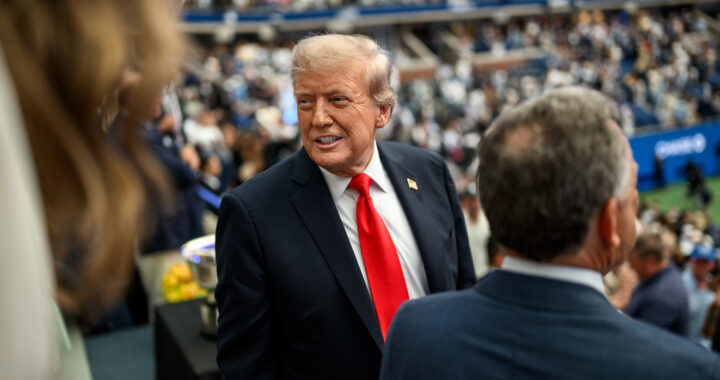
Not all Republicans agree with Donald Trump. This has been the case since his first term. But the second Trump administration has resulted in a further fracturing within the party. Even voters and figures who elected and supported Trump in the presidency during the 2024 election are now growing dissatisfied with how he has been leading the United States.
Republicans Against Donald Trump: Polls and Turnouts From Republican Voters and Disagreements and Misalignments Among Various Right-Leaning Factions
Deteriorating Support From Republican Voters
A series of polls reveals Republican voters who are dissociating themselves with the MAGA movement and expressing dissatisfaction with the second Trump administration. The 2025 off-year elections also delivered a sweeping blue wave that reflected not only Democratic momentum but also Republican erosion.
Data from The POLITICO Poll and Public First, which was explained by Adam Wren, showed that more than 30 percent of Republican voters do not consider themselves aligned with the MAGA movement. These individuals are not only less loyal to Trump. The poll has indicated that some of them have grown dissatisfied with the second Trump administration.
Moreover, in a particular survey by the same institutions conducted between 18 and 21 of October 2025, 31 percent of those who voted for Trump in the 2024 election believed that the best times of the United States are in the past. Another November poll revealed that 59 percent of non-MAGA voters are concerned about the current cost of living in the country.
Another poll conducted by the Pew Research Center in October 2025 found that a staggering 55 percent of Hispanic Republicans believe that the immigration and economic policies of Trump are hurting their group. This is a 17 percentage point increase from the first Trump administration, when only 38 of Hispanic Republicans shared the same sentiment.
The off-year election for gubernatorial and state legislative positions held in November 2025 underscored the growing unpopularity of Trump and the general Republican agenda within the Republican base. Democrats won the New Jersey and Virginia governorships by wide margins, and a Democratic Socialist now serves as mayor of New York City.
Moreover, in the Supreme Court of Pennsylvania, the Democrats kept 3 liberal justices, each with a 10-year term, thus maintaining swing-state court control. The party also overturned 2 Public Service Commission seats in the swing state of Georgia and won a redistricting ballot measure in California. There were also Democratic gains in various U.S. cities.
The 2025 off-year election has been widely considered a blue wave election. Democratic success in the various elections was attributed to the growing concerns over the economy. The separate reports by Karissa Waddick of USA Today and Christian Paz of Vox explained that Hispanic voters pivoted hard from the Republican Party to the Democratic Party.
It is worth reiterating and highlighting the fact that the trends within the Republican base of voters are indicators of disapproval and non-alignment with the policies and actions of Trump and his entire administration. These include the controversial Trump tariffs and their perceived and real economic implications, and the harsh crackdown on immigration.
Factions Within the Collective Right-Wing Party
Policies have become a flashpoint for Republican division. The collective right-wing is also divided into multiple factions. The MAGA movement is still dominant, but traditional conservatives are wary of populism. Segments of the far-right, once assumed to be natural Trump allies, have turned sharply against him.
The fractures also go deeper within the Republican Party and associated groups. Notable figures have withdrawn support starting in the 2024 election. These include former U.S. Vice President Mike Pence, who was in office under the first Trump administration, and several former cabinet officials like John Bolton, Dan Coats, Mark Esper, and Jim Mattis.
A high-profile feud also ensued between the U.S. president and representatives Marjorie Taylor Greene and Thomas Massie following the release of fresh batches of Epstein files in November 2025 that resulted in a renewed call for the further release of remaining files. The Epstein issue has become one of the pain points of the second Trump administration.
The Republican Party is also struggling to agree on several policy issues. For example, five out of 21 Republicans, which included Ralph Norman of North Carolina, blocked the flagship tax and spending bill on 17 May 2025. These lawmakers are considered hardline Republicans who want a more conservative version of the bill aimed at cutting spending further.
Note that the U.S. Senate passed a resolution on 30 October 2025 that would roll back many of the tariffs imposed by the second Trump administration with a 51-47 vote. 4 Republicans sided with the Democrats in the decisive vote due to concerns over prices and the domestic economy. These included Thom Tillis of North Carolina and Ran Paul of Kentucky.
Republicans are divided into numerous factions. The MAGA faction is the most dominant group, and it has Trump and U.S. Vice President J.D. Vance as key figures. It has strong personal loyalty to Trump and follows a populist nationalist political perspective. They support the America First foreign policy of the administration and Trump-backed tariffs.
Long-serving politicians like Mitch McConnell, John Thune, Tim Scott, and Nikki Haley form the traditional conservative faction within the Republican Party. They have strong support for foreign alliances and traditional U.S. global leadership. This group is also concerned that Trump-centered populism and Trump-style rhetoric harm long-term electoral viability.
There are also far-right groups that are outright anti-Trump. These include white supremacists or neo-Nazi movements and ultra-conservative Christian nationalists like the Groypers and the Aryan Freedom Network. Ben Makuch of The Guardian noted some far-right individuals have viewed Trump as an enemy and consider his administration to be too moderate.
Implications for Donald Trump and the Republican Party: The Challenges in Maintaining a Broad and Unified Big Tent Coalition That Satisfies All Voters and Factions
The polls and election turnouts reveal that the phenomenon behind the fracturing Republican base touches on multiple dimensions. These include economics, identity, foreign policy, education, information. These factors create overlapping fault lines that make it challenging to maintain a broad and unified big tent coalition that can rally behind Donald Trump.
Moreover, when it comes to governance affairs, the division in the Republican Party risks policy incoherence. When Republicans disagree sharply on tariffs, trade, spending, and foreign policy, it becomes harder to maintain a unified stance, thus making it difficult or impossible for the second Trump administration to advance its office-defining political agenda.
The sentiments against the policy of Trump also raise uncertainty for electoral prospects. In swing districts or policy-sensitive states, Republican politicians who break with Trump might appeal more to local voters but risk alienating the MAGA base. Those prioritizing base loyalty through an evident pro-Trump risk losing moderate or independent voters.
Note that the factions within the collective right-wing political line is not based on ideologies. It is also personal, strategic, demographic, and institutional. Trump is still the strongest gravitational force, but multiple factions now diverge from him on economics, foreign policy, or party strategy. The Republican Party also now resembles a coalition of overlapping tribes.
It is also worth mentioning that the traditional narrative that far-right groups automatically support both Trump and his entire administration is no longer always true. Some now see the U.S. president as compromised or inadequate for their goals. This shift does not mean far-right opposition to Trump is large or mainstream. Most operate outside formal politics.
The widening fractures among Republican voters, prominent figures, and competing factions indicate that the party faces a pivotal moment under the second Trump administration. These divisions, amplified by economic strain and electoral setbacks, suggest a shifting landscape that will shape future political dynamics and national leadership directions
FURTHER READINGS AND REFERENCES
- Im, C. and Noe-Bustamante, L. 24 November 2025. “Majorities of Latinos Disapprove of Trump and His Policies on Immigration, Economy.” Pew Research Center. Available online
- Levine, S. 5 November 2025. “Pennsylvania Keeps Three Liberal Justices, Preserving Swing-state Court Control.” The Guardian. Available online
- Makuch, B. 11 August 2025. “Trump Stirs Far-Right Rage Despite FBI Deprioritizing Extremist Threat.” The Guardian. Available online
- Morgan, D. and Erickson, B. 17 May 2025. “Republicans Spike Trump Tax Bill Over Spending Worries, Moody’s Cuts US Rating.” Reuters. Available online
- Paz, C. 6 November 2025. “Republicans May Have a Latino Problem (Again). Vox. Available online
- The POLITICO Poll and Public First. n.d. The POLITICO Poll. Available online
- Waddick, K. 7 November 2025. “Republicans are Losing This Key Voting Bloc. Here’s Why.” USA Today. Available online
- Wren, A. 28 November 2025. “How Trump’s Base Could Break.” Politico. Available online