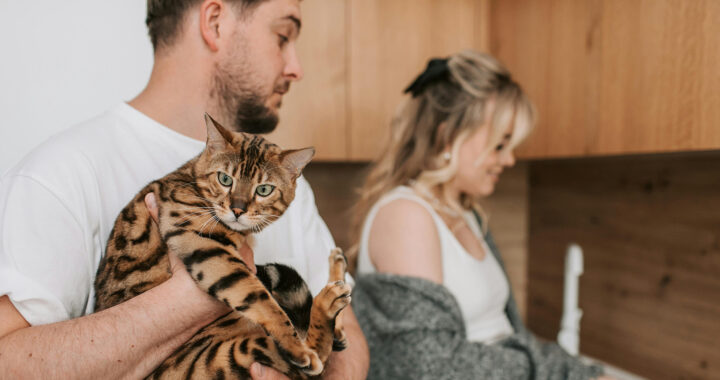
Cats are popular pets, but unlike dogs, their social behavior toward humans is less studied. Both scientists and pet owners know that animals often use greetings to maintain social bonds, but it was unclear how domestic cats greet their human caregivers in everyday home settings. This was the focal point of research led by a team of researchers in Turkey. Their paper was published on 14 November 2025 in Ethology with Y. S. Demirbaş as the first author.
Domestic Cats Display Complex Greeting Behavior Toward Human Caregivers and They Meow More Frequently Toward Their Male Caregivers
A study found that cats vocalize more frequently toward male caregivers than female caregivers. This suggests that human traits influence feline social behavior and underscores their selective responsiveness and sophisticated social awareness in everyday home interactions.
Exploring Further Feline Social Behaviors
Previous studies on cat behavior mostly focused on interactions in labs or short observations. This means scientists lacked information on natural and real-life cat-human greetings. The researchers wanted to find out what types of behaviors cats show, whether these behaviors are consistent, and if factors like the sex of the caregiver influence how cats greet them.
Hence, in their research pursuit, the team observed and examined how 31 domestic cats greet their human caregivers in their natural home environments using 22 behavioral measures. These include feline vocalizations, posture, movement, and other gesture-related behaviors. A total of 100 seconds of greeting sessions were recorded for each domestic cat.
Correlation analyses were conducted to identify patterns in how the various behaviors clustered or occurred with one another. The researchers also tested whether demographic variables like the sex of the human caregiver, number of cats in the household, and feline sex, age, and pedigree status related systematically to the greeting behavior exhibited by the cats.
Insights Into Cat-Human Social Dynamics
Results suggest that greeting in cats is not a simple and uniform vocalization. Instead, it involves a mixture of behavioral components that combine vocal signals and body language or movement signals. The behaviors were grouped into two patterns: either affiliative or displacement-like. This suggests that cat greeting is emotionally or motivationally layered.
Take note that affiliative behaviors are friendly or welcoming signals that include approaching the human, purring, rubbing, and tail movements. These actions show positive social intent and willingness to interact. Displacement-like behavior includes actions that may indicate uncertainty or mild anxiety. These include hesitation, moving away, or tail flicking.
Cat greetings were shown to follow predictable patterns that often pair vocalizations with specific body movements. These structured behaviors reveal that cats communicate intention and emotion in a sophisticated and socially aware manner when interacting with humans. They have nuanced social intelligence that adapts depending on the situation.
Moreover, aside from the aforementioned, another interesting finding is that domestic cats tend to vocalize more frequently toward their male caregivers than toward female caregivers. No other tested demographic factors appeared to influence the frequency or duration of greeting behaviors. The only clear external predictor was the sex of the human caregiver.
Specific results indicate statistical significance. The observations showed an average of 4.3 direct meows in the first 100 seconds of greeting with a male caregiver. This is considerably higher than the average for female caregivers, which was only 1.8 direct meows in the first 100 seconds. The difference indicates caregiver sex influences feline communication.
The tendency to vocalize more with male caregivers suggests that domestic cats may perceive or react differently depending on human characteristics. These include differences in voice pitch, scent, interaction patterns, or past experiences. This suggests that social dynamics between cats and their caregivers might be more sensitive than often assumed.
Further Discussions and Key Implications
The study did not determine a definitive cause why domestic cats vocalize more frequently toward male caregivers. Several assumptions may account for this behavior. One is that male voices tend to be deeper or have a lower pitch, and cats may find these tones more attention-grabbing or easier to distinguish, leading to more vocal back-and-forth during greetings.
Previous studies, including the separate works of D. C. Turner and M. L. Brennan et al, examined human-cat interactions and suggested that men tend to use more movement-based or brief conversational interaction, while women often use longer verbal exchanges. Cats may meow more with men because the short, clear cues create more vocal turn-taking.
There could be other factors behind the phenomenon. However, none of these studies provides definitive evidence that he increased meowing toward male caregivers is due to a single trait. The explanations remain a working hypothesis. The researchers themselves frame their separate explanations as plausible interpretations rather than confirmed facts.
FURTHER READINGS AND REFERENCES
- Demirbaş, Y. S., Kerman, K., Atılgan, D., Ünler, M., Yildirim, T., and Şimşek, S. 2025. “Greeting Vocalizations in Domestic Cats Are More Frequent With Male Caregivers.” Ethology. DOI: 1111/eth.70033
- Finka, L. R., Ripari, L., Quinlan, L., Haywood, C., Puzzo, J., Jordan, A., Tsui, J., Foreman-Worsley, R., Dixon, L., and Brennan, M. L. 2022. “Investigation of Humans Individual Differences as Predictors of Their Animal Interaction Styles, Focused on the Domestic Cat.” Scientific Reports. 12(1). DOI: 1038/s41598-022-15194-7
- Turner, D. C. 2021. “The Mechanics of Social Interactions Between Cats and Their Owners.” Frontiers in Veterinary Science. 8. DOI: 3389/fvets.2021.650143h