Complete data from the Bureau of Economic Analysis and the Census Bureau of the United States Department of Commerce for 2025, which were generally delayed due to the federal government in November 2025 and other unexplained reasons, have revealed that the U.S. trade deficit barely budged despite the aggressive tariffs of the second Trump administration.
United States Trade Deficit in 2025 Reached USD 901.5 Billion: Evidence Against the Tariffs Imposed by and the Protectionist Policy of the Second Trump Administration
Tariffs and Trade Deficit
A particular report by the Department of Commerce, which was released on 19 February 2026 via the U.S. Census Bureau, revealed that the persistent and problematic trade deficit of the United States reached 901.5 billion U.S. dollars in 2025. This figure represented a very slight 0.2 percent decrease from the 904 billion U.S. dollars deficit recorded in 2024.
The data showed a massive gap between imports and exports. Moreover, while the total gap narrowed by 2.2 billion U.S. dollars, the deficit remained near the historical record of 923.7 billion U.S. dollars set back in 2022. These figures contradict the claim made by U.S. President Donald Trump that his Liberation Day tariffs slashed the trade deficit by 78 percent.
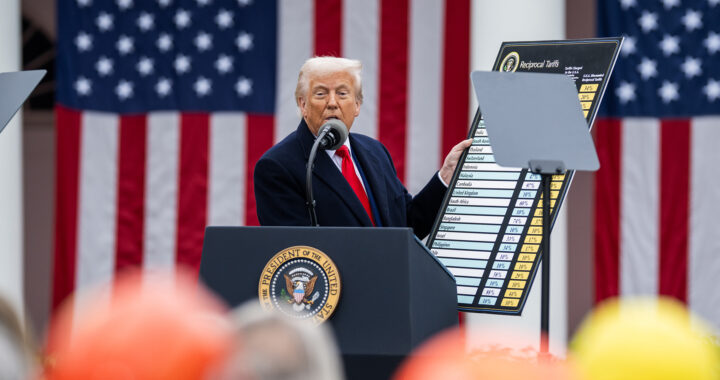
Note that the second Trump administration rolled out its so-called Liberation Day tariffs in April 2025. These are reciprocal import duties that range from 10 percent to 50 percent on imported products coming from over 100 countries. The tariffs were determined based on the magnitude of trade deficits and an assessment of the trade practices of the involved countries.
For example, China had a 295 billion U.S. dollars trade deficit and 440 billion U.S. dollars in imports. This means 295 billion was divided by 440 billion to come up with 67 percent. This was then halved to 34 percent. The existing 20 percent tariff was added to produce the 54 percent total tariff rate. The same formula was applied for the European Union.
Impact of Trump Tariffs
Remember that Trump has been hiking tariffs as part of his protectionist economic policy and also as an attempt to maintain economic influence as part of his foreign policy. However, despite repeated claims that his aggressive stance has produced measurable and impactful economic results, there were notable but reasonable consequences. Take note of the following:
• Front-Loading and Eventual Narrowing
The data shows that the trade gap surged in the first quarter of 2025. This was driven by the fact that U.S. companies rushed to import foreign goods before the new tariffs took effect to avoid the higher costs.
A post-tariff gap narrowing then ensued. Specifically, after the initial trade gap surge, the monthly deficit narrowed, hitting its lowest level since 2009 in October 2025, before widening again in December 2025.
Overall trade deficit still rose as early as May 2025 to reach 96.6 billion U.S. dollars. This was 11 percent higher than April 2025 and 6.5 percent higher than the forecast. The Census Bureau noted a drop in exports as a key driver.
• Significant Diversion of Trade Patterns
The Trump tariffs caused trade diversion rather than a simple reduction in the deficit. The goods deficit with China plunged nearly 32 percent to 202 billion U.S. dollars due to Trump focusing on Chinese manufacturing.
However, as trade moved away from China, it shifted to other Asian nations. The goods gap with Taiwan doubled to 147 billion U.S. dollars, and the gap with Vietnam rose 44 percent to 178 billion U.S. dollars. This was largely driven by U.S. demand for computer chips and AI-related technology products.
Note that Mexico remained a primary source of imports. The goods gap with Mexico widened to 197 billion U.S. dollars. The deficit with Canada, on the other hand, shrank by 26 percent to 46 billion U.S. dollars.
• Notable Economic Winners and Losers
The goods-only deficit actually hit a record 1.24 trillion U.S. dollars. This was a 2 percent increase from 2024. This was offset by a strong performance in services, in which the U.S. ran a surplus of 339 billion U.S. dollars.
Several observers originally feared the tariffs would trigger a spike in inflation, but the real impact on inflation in 2025 was less severe than many experts had predicted. This could stem from U.S. businesses absorbing costs.
Trump argued that tariffs would bring manufacturing back to the U.S. However, the record goods deficit suggests that U.S. reliance on foreign-made products, especially in the tech sector, remained high throughout 2025.
FURTHER READINGS AND REFERENCES
- Garcia, C. 28 June 2025. “Trump Tariffs Not Working: U.S. Trade Deficit Surged in May 2025. Konsyse. Available online
- United States Census Bureau. 19 February 2026. S. International Trade in Goods and Services, December 2025. United States Census Bureau. Available via PDF