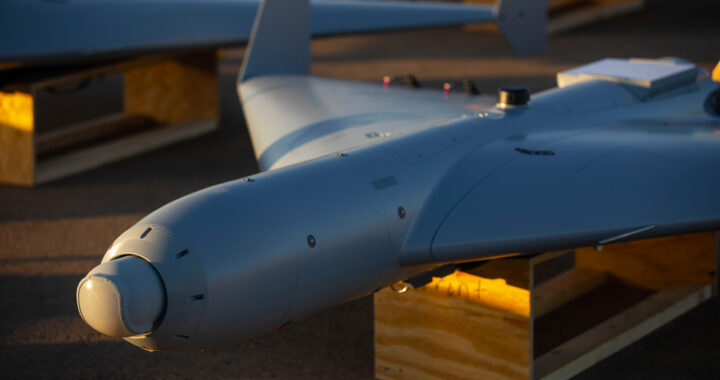
The United States, for the first time in its long military history, has demonstrated the integration of attack drones in its offensive weapons arsenal. It officially debuted the domestically produced Low-cost Uncrewed Combat Attack System or Lucas drones in its war with Iran. These munitions are used alongside Tomahawk missiles and newer precision strike missiles.
The United States Used One-Way Uncrewed Attacked Drones For the First Time During Its War With Iran
Low-cost Uncrewed Combat Attack System, known as LUCAS, represents a shift in military strategy toward inexpensive, expendable drones designed for one-way attack missions.
Development
Specifically, in observing how drones such as the Iranian-designed Shahed series reshaped battlefield tactics, the United States sought to create a similar system capable of rapid deployment and large-scale production.
It is worth mentioning that the Lucas drones are based on the infamous Shahed drones of Iran. The U.S. government realized the effectiveness of cheap mass-produced drones after witnessing how the Armed Forces of Russia has used Iranian-produced attack drones to launch cost-effective and long-range offensive assaults in its ongoing war with Ukraine.
Specifically, the U.S. government got hold of several Shahed drones. The military studied these munitions, and specific researchers reversed-engineered several of their design elements. The U.S. Department of Defense sought a U.S. equivalent capable of rapid mass production. SpektreWorks, a defense contractor based in Arizona, landed the manufacturing contract.
The Lucas drones were unveiled at the Pentagon on 16 July 2025 as part of a public demonstration of autonomous systems intended to accelerate U.S. drone capabilities. Mass production was targeted in December 2025. However, following the war with Iran at the end of February 2026, the U.S. has shown that it has existing stockpiles of these assault drones.
Characteristics
The drones are designed to deliver precision strikes without the financial burden of traditional cruise missiles. This lower cost allows militaries to deploy large numbers of drones to potentially overwhelm enemy defenses through saturation attacks.
Lucas drones closely resemble the Iranian Shahed-136 drones but incorporate some engineering improvements. They are also specifically categorized as military loitering munitions or kamikaze drones designed to perform one-way strike missions against enemy targets and saturate the aerial defense capabilities of enemies through a large-scale drone barrage.
Each drone has a length of about 10 feet and has a wingspan of about 8 feet. It runs on a 215 cubic centimeter internal-combustion piston engine. The drone has a range of about 800 kilometers or 500 miles or more, depending on configuration. It can cover a distance of about 200 kilometers per hour. Each drone can carry a payload of about 30 to 50 kilograms.
The extremely low production cost of Lucas drones signals an improvement to the U.S. offensive capabilities. Each costs around 35000 U.S. dollars. Note that a Hellfire missile costs about 150000 U.S. dollars, while each Tomahawk missile costs between 1 million and 2 million U.S. dollars. Lucas drones are also compatible with different launch methods.
Moreover, unlike earlier drones, Lucas drones can integrate with network-centric warfare systems with their networked and swarm capabilities. These include communication relay between uncrewed systems, coordination with other drones, swarm tactics, and integration with the MUSIC or the U.S. Multi-Domain Unmanned Systems Communications Network.
Implications
One-way assault drones represent modern warfare. The modern battlefield is seen to shift toward persistent aerial threats, rapid drone deployment, and new defensive challenges against swarms of autonomous weapons.
The development and deployment of Low-cost Uncrewed Combat Attack System or Lucas drones by the U.S. Armed Forces has a considerable level of military, strategic, economic, and geopolitical implications. Specifically, following the examples of Russia and Iran, modern warfare now leans toward cheap and expendable autonomous weapons used at scale.
It also signals a shift in the U.S. military doctrine. Traditional Western aerial offensive strategy was based on expensive platforms such as fighter aircraft and cruise missiles. The ongoing Russia-Ukraine War and the 2025 drone strikes of Iran to Israel have demonstrated both the cost-effectiveness and reliable reach of mass-produced assault drones.
The Operation Spiderweb of Ukraine also showed the importance of drones in tilting the balance of war with proper planning. Furthermore, in response to the Operation Epic Fury, an aerial assault in Iran by the U.S. and Israel, Iran exposed the daunting cost imbalance between offense and defense since its Shahed drones cost a fraction of interceptor missiles.